
Retrofit Emission Control Device (RECD)
What an RECD is, why it is fitted to diesel generator sets, how it works and what it needs to stay effective — explained without jargon.
The short answer
An RECD is an exhaust after-treatment unit that is added to an existing diesel generator set to reduce the particulate matter in its exhaust. It is fitted on the exhaust path between the engine and the stack, so the generator itself is not replaced or rebuilt.
1. What RECD means
RECD stands for Retrofit Emission Control Device. Each word carries meaning:
- Retrofit — the device is fitted to equipment that is already installed and in service, rather than being built into a new generator.
- Emission — it acts on what leaves the engine, specifically the exhaust gas stream.
- Control — its purpose is to reduce a pollutant in that stream, chiefly particulate matter.
- Device — it is a physical piece of equipment: a housing with an internal filter element, inlet and outlet connections, and provisions for servicing.
In practice, an RECD looks like a heavy fabricated steel or stainless-steel canister installed in the exhaust line. Depending on the model it may include a filter element, a mounting frame, flanges, drain points and instrumentation connections.
2. Why RECD is used on diesel generator sets
Diesel generator sets are essential for backup power in hospitals, factories, IT facilities, hotels, apartments and commercial buildings. When a generator runs, its exhaust carries particulate matter — the visible and invisible solids produced by diesel combustion.
An RECD is fitted for reasons such as:
- Controlling particulate emissions from an existing genset without replacing it
- Supporting applicable pollution-control requirements and internal environmental targets
- Improving the quality of exhaust released near occupied buildings, generator rooms and stack locations
- Extending the useful life of a serviceable generator by addressing emissions at the exhaust stage
What an RECD does not do: it is not a fuel-saving device, and fitting one does not by itself certify compliance with any regulation. Compliance depends on the applicable rules for your site, the DG set and how the equipment is operated and maintained. Please confirm requirements with your consultant or the concerned authority.
3. Diesel generator emissions in simple terms
Diesel exhaust is a mixture of gases and solid particles. For an RECD conversation, three things matter:
- Particulate matter (PM) — soot and associated particles. This is what an RECD is primarily selected to control.
- Visible smoke — the dark plume often seen under load changes. Smoke is a visible symptom of particulate loading.
- Exhaust temperature and flow — both change with load. They determine which device construction and filter medium suit your generator.
Because these characteristics vary with engine size, load profile and maintenance condition, the same device cannot be prescribed for every genset. That is why suitability is assessed per installation.
4. How an RECD works
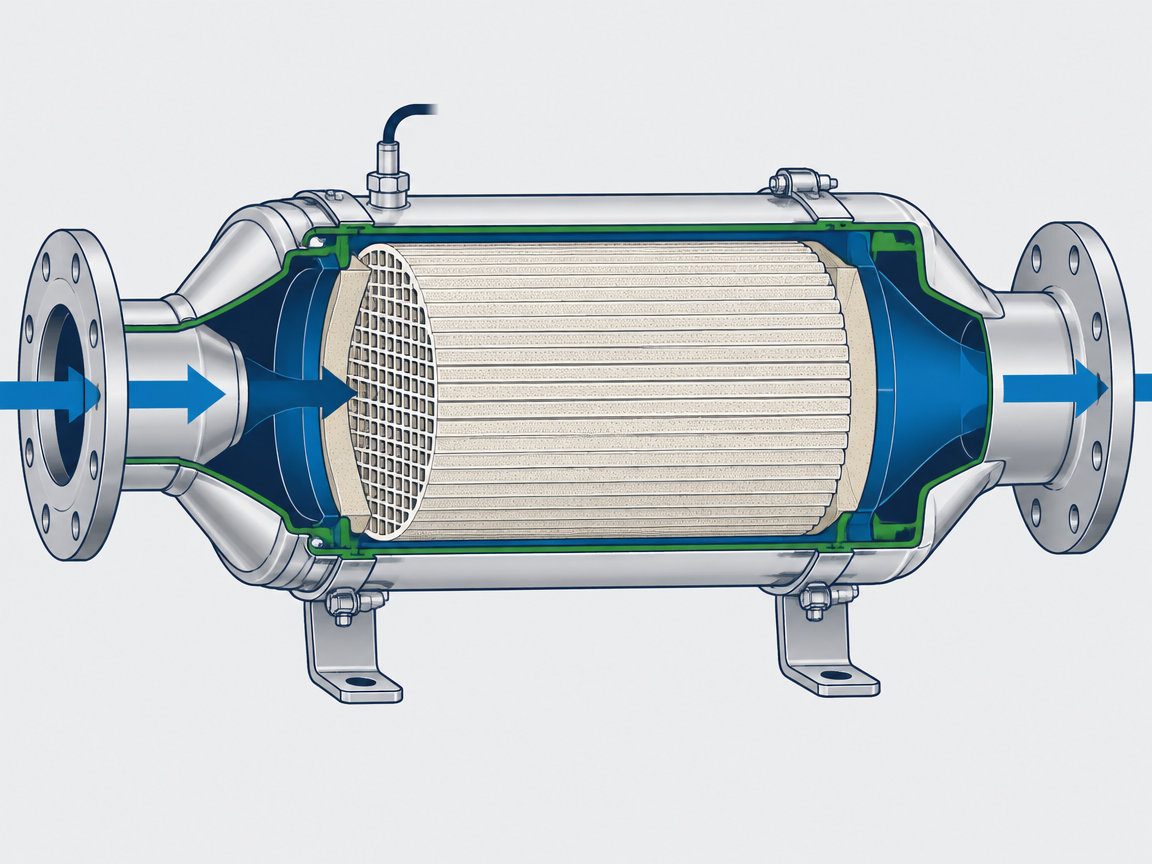
- Exhaust enters the inlet. Hot exhaust gas leaves the engine manifold or turbocharger and is routed into the RECD housing.
- Flow is distributed. Internal geometry spreads the gas across the filter face so the whole element is used, not just the centre.
- Particulate matter is captured. As gas passes through the filter medium, solid particles are retained on and within the element.
- Treated gas leaves the outlet. The cleaned gas continues into the existing silencer or stack and is released to atmosphere.
- The element is serviced periodically. Captured material accumulates over time, so the element is cleaned or replaced according to the manufacturer's schedule.
A well-designed installation keeps exhaust back pressure within the engine manufacturer's limits. Back pressure is the resistance the engine must push against; too much of it affects performance and fuel consumption. This is one of the main reasons a correctly sized device matters more than a large one.
5. Emission control technology inside the device
RECD products in the market use different internal approaches. The most common construction is a wall-flow or partial-flow filter element housed in a steel shell, where the exhaust is forced through a porous medium that traps particles. Some designs combine filtration with catalytic coating or with additional settling chambers to manage the collected material.
Which technology suits a given site depends on the engine, the duty cycle (standby versus continuous running), fuel quality, available space and the maintenance capability of the site team. We confirm these points with you before recommending a model, and we explain the trade-offs honestly rather than presenting one product as universally best.
6. Where RECD units are used
- Manufacturing plants and factories
- Hospitals and healthcare campuses
- Hotels and resorts
- Educational institutions and campuses
- IT parks and office buildings
- Apartment complexes and residential societies
- Shopping malls and retail centres
- Construction sites and batching plants
- Warehouses and logistics facilities
- Institutions and government facilities
7. Advantages of fitting an RECD
- Addresses emissions without replacing the genset. A serviceable generator stays in service.
- Targets the pollutant that matters most visibly. Particulate control improves exhaust quality and reduces visible smoke.
- Fits into existing installations. Retrofit units are designed to be integrated into an existing exhaust line.
- Supports environmental planning. Useful where a site is documenting emission control measures.
- Serviceable by design. Filter elements are accessed for cleaning or replacement as part of routine maintenance.
Read the full benefits of RECD
8. Maintenance considerations
An RECD is equipment, not a fit-and-forget accessory. Plan for the following from the start:
- Access. Leave room to open, remove and refit the filter element. Cramped installations make every future service harder.
- Cleaning interval. Depends on running hours, load profile and fuel quality. The manufacturer's schedule is the reference.
- Back pressure checks. Rising back pressure is the clearest signal that the element needs attention.
- Record keeping. Log services, element changes and any engine work so the installation history is clear.
- Genset health. Excessive smoke from an engine fault will load the filter faster. Fix engine problems first.
9. What we check before recommending a device
If you already know the category of device you need, tell us and we will confirm it against your installation. The points below are what we review:
| Factor | Why it matters |
|---|---|
| DG capacity (kVA) | Determines exhaust flow and the size class of the device. |
| Number of DG sets | Affects quantity and whether sets share a common exhaust route. |
| Duty cycle | Standby, prime or continuous running changes filter loading. |
| Exhaust routing | Available space, bends, stack height and silencer position. |
| Site district | Determines supply and installation coordination logistics. |
Looking for the right RECD for your DG set?
Share your capacity, quantity and district — we will confirm suitability and send a quotation.