
How Does an RECD System Work?
How it works · 6 min read · Trishul Kosmic Energy
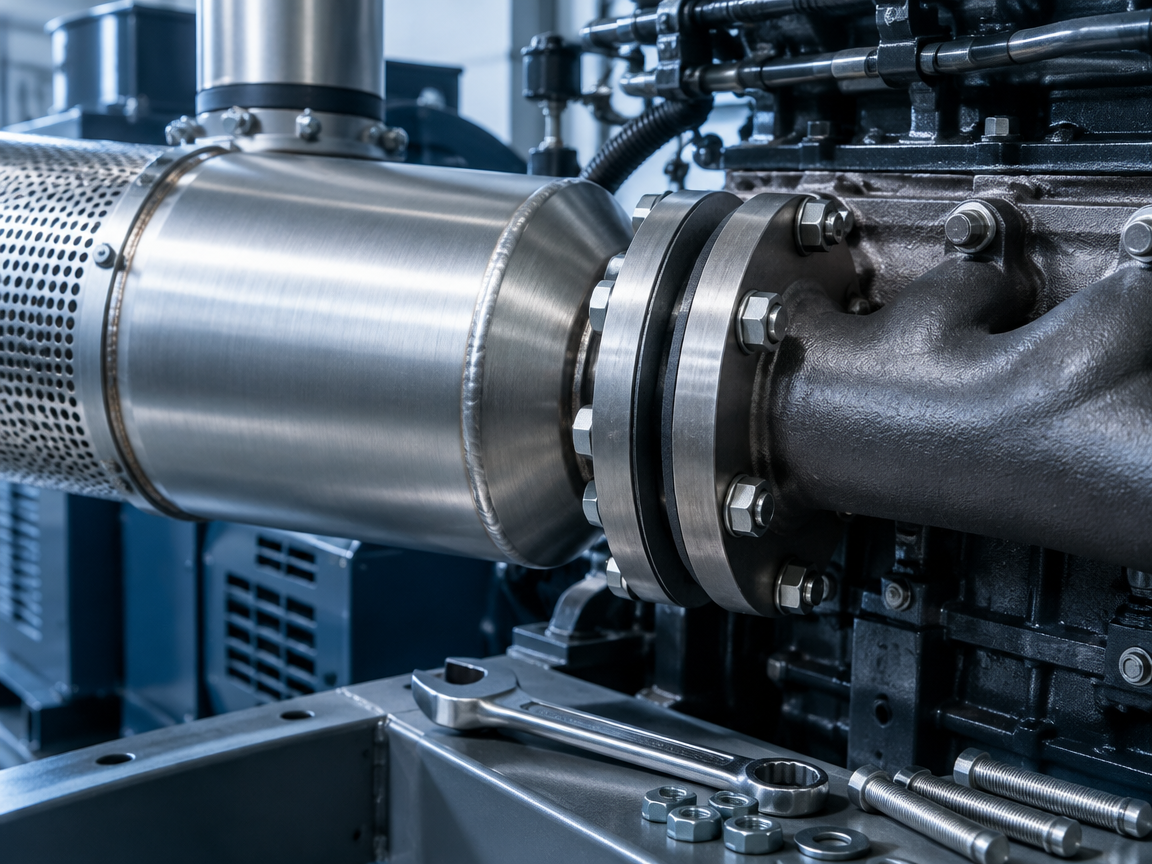
An RECD is simple in concept and fussy in detail. The concept: push exhaust through a filter before it leaves the stack. The detail: the device has to do that without choking the engine, and it has to be serviceable for years.
Step 1 — Exhaust leaves the engine
Hot exhaust gas leaves the engine manifold or turbocharger and travels along the exhaust pipe. At this point the gas carries particulate matter, unburnt hydrocarbons and heat. The temperature and flow rate rise and fall with engine load.
Step 2 — The device accepts the flow
The inlet flange connects the RECD to the exhaust line. Inside, a distribution section spreads the gas across the full face of the filter element. Good distribution matters: if all the gas hits the centre of the element, that area blinds over quickly and the rest of the element does nothing.
Step 3 — Particulate matter is captured
As gas passes through the filter medium, solid particles are trapped on the surface and inside the porous structure. This is where the emission benefit actually happens. The medium may be ceramic, metallic or a combination, depending on the product.
Step 4 — Cleaned gas exits
Treated gas leaves through the outlet and continues into the existing silencer or straight up the stack. The silencer still does its acoustic job; the RECD does the filtration job.
Step 5 — Collected material is dealt with
Captured particulate does not disappear. It accumulates in the element and must be removed by cleaning or by replacing the element. Some designs include a drain or ash port to help with this. The service interval depends on running hours, load profile and fuel quality.
Why back pressure decides everything
Every component added to an exhaust line adds resistance. That resistance is back pressure, and the engine manufacturer sets a limit for it. Exceed the limit and you affect combustion, power output, fuel consumption and exhaust temperature.
Back pressure rises as the filter loads with particulate. This is why a device is sized with headroom and why monitoring back pressure is the single most useful maintenance signal you have. A gauge or a periodic reading is worth more than guesswork.
What this means for your purchase
- Size for your DG capacity and duty cycle, not for the biggest unit that fits.
- Plan the installation so the element can be removed without dismantling the exhaust.
- Ask what back pressure the device adds when clean, and what limit applies to your engine.
- Agree who cleans the element and how often, before installation day.
Want a suitability check?
Share your DG capacity, brand and site district. We will confirm the right configuration.
Talk to Our RECD Experts
Based in Mysuru, supporting customers across Karnataka.